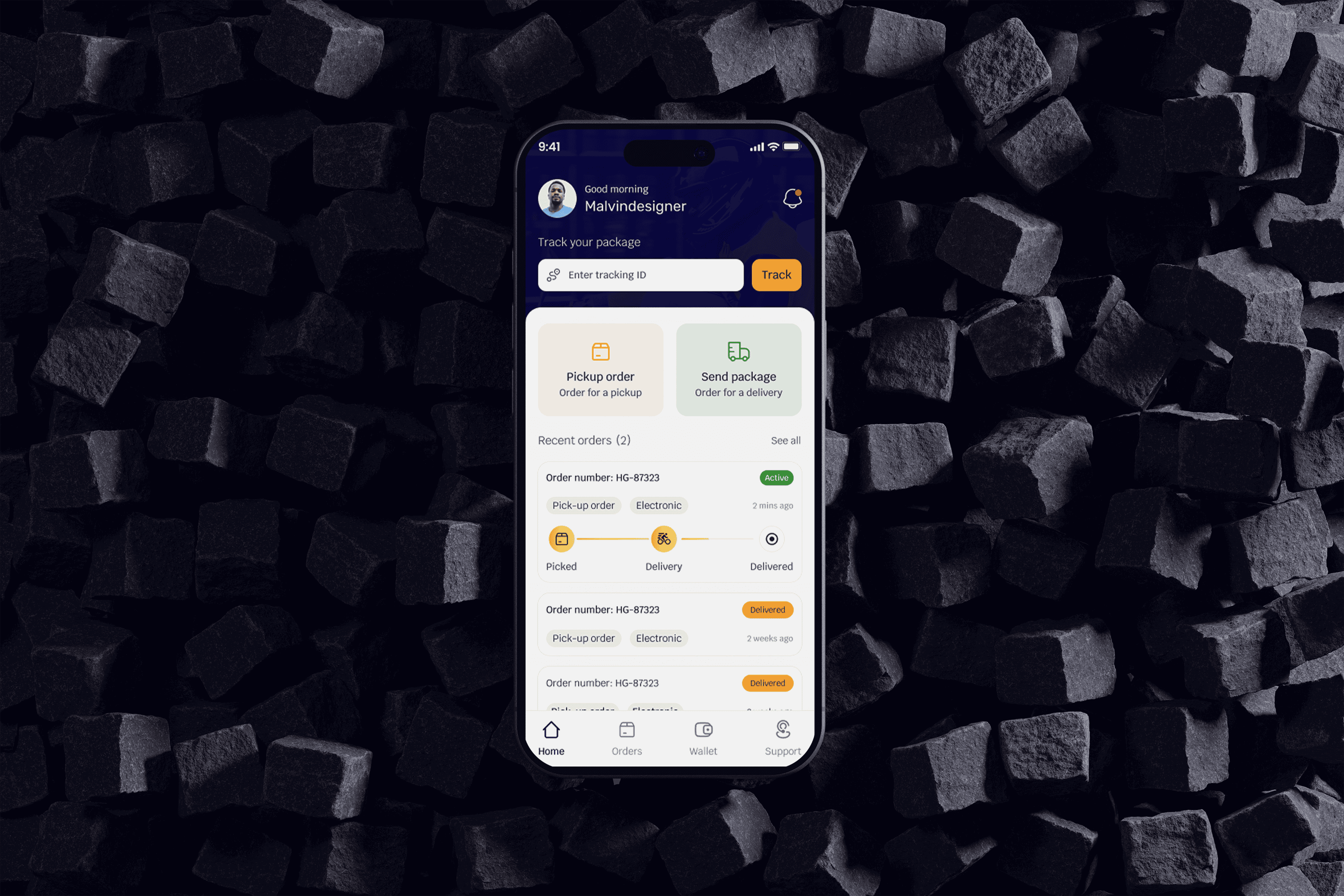
A customer books a delivery. A rider picks it up. Operations keeps things moving. I designed Hegmolf around the handoffs between those people, because that is where a simple delivery can become a confusing one.
I led the design across the customer app, rider experience, operations dashboard, and supporting web experience. I connected research, product structure, interactions, reusable components, and handoff into one delivery model.
Team
Malvin YaaBari
End-to-end Product Designer
Cross-functional partners
Product management, product ownership, engineering, QA, and operations
Hegmolf supports package pickup and delivery in Nigeria. The product has several interfaces, but they all describe the same job. A customer action changes what a rider needs to do, and both affect what operations needs to see.
Across a 20-week design engagement, I worked on booking, tracking, rider tasks, operational visibility, and the product’s web entry point. My responsibility was to make those experiences work together without giving everyone the same information hierarchy.
Challenge
A handoff should not become a blind spot.
The delivery journey depended on several people understanding the current state. I needed to make the next action clear for each person while keeping the underlying journey consistent.
Customer
What is happening with my package? Give the customer progress and reassurance.
Rider
What do I need to do now? Put the active delivery task first.
Operations
What needs attention? Make the delivery work visible enough to act on.
Discovery & strategy
I mapped where responsibility changes hands.
I used the research and delivery-flow work to look beyond isolated screens. The most useful questions were about handoffs: what information must be collected, who uses it next, and how a change becomes visible to the other people involved?
Reassurance is more than a map
Tracking needs to explain the state of the delivery as well as its location.
One journey needs different views
Customers need clarity, riders need action, and operations needs an overview. Consistency does not require identical screens.
The delivery flow makes the handoffs visible before they are translated into customer, rider, and operations screens.
Design decisions
Give each person a useful view of the same job.
Open a decision to see what I chose, the trade-off, and the question I would use to evaluate it.
Break booking into a focused sequence.
The choice. I grouped pickup, destination, and package information around the task rather than one long collection of fields.
The trade-off. More steps can feel slower if their purpose is unclear, so every stage needs a clear job.
What I would check. I would check completion, corrections, and where people hesitate before claiming an improvement in booking time.
Let the delivery state guide the interface.
The choice. I used the active stage to shape what information and actions matter next.
The trade-off. A single status needs to remain consistent across customer, rider, and operations views.
What I would check. I would review the state transitions and exception cases with engineering and operations.
Let operations see more without creating noise.
The choice. I gave the dashboard a denser overview while keeping customer and rider views focused on their immediate task.
The trade-off. Density helps operational scanning until competing elements make priority hard to see.
What I would check. I would test whether someone can identify and investigate an order that needs attention.
Solution
Follow the delivery from three sides.
Choose a perspective below to see how the shared delivery model becomes a different, focused interface for each person.
Book with context. Track with confidence.
The booking sequence collects the information needed for a delivery, then tracking keeps the journey visible. The customer should not need to understand the operations behind the service.
Customer — open the product screens to inspect the details.
Keep the next task in front of me.
The rider experience brings pickup, destination, and delivery actions into a task-focused view. The goal is to support the work happening on the road.
Rider — open the product screens to inspect the details.
See the work that needs a decision.
The dashboard brings delivery activity together for monitoring and investigation. It gives the team a wider view than the customer or rider needs.
Operations — open the product screens to inspect the details.
Outcomes & learnings
The strongest part is the connection between views.
The delivered design brings customer, rider, and operations work into one coherent delivery journey. It gives each person a focused interface while keeping the stages of the service understandable across the product.
Connected booking
A focused sequence collects delivery information.
Visible progress
Tracking explains the journey after a booking.
Operational context
A dedicated dashboard supports the wider delivery workload.
What I would take into the next iteration.
This project made me more deliberate about designing between screens. The next iteration would focus on failed deliveries, unavailable riders, and poor connectivity, then evaluate how well those exceptions carry through every view.